



Washable Bed Pads — A Sustainable Alternative to Disposables
10.06.2026
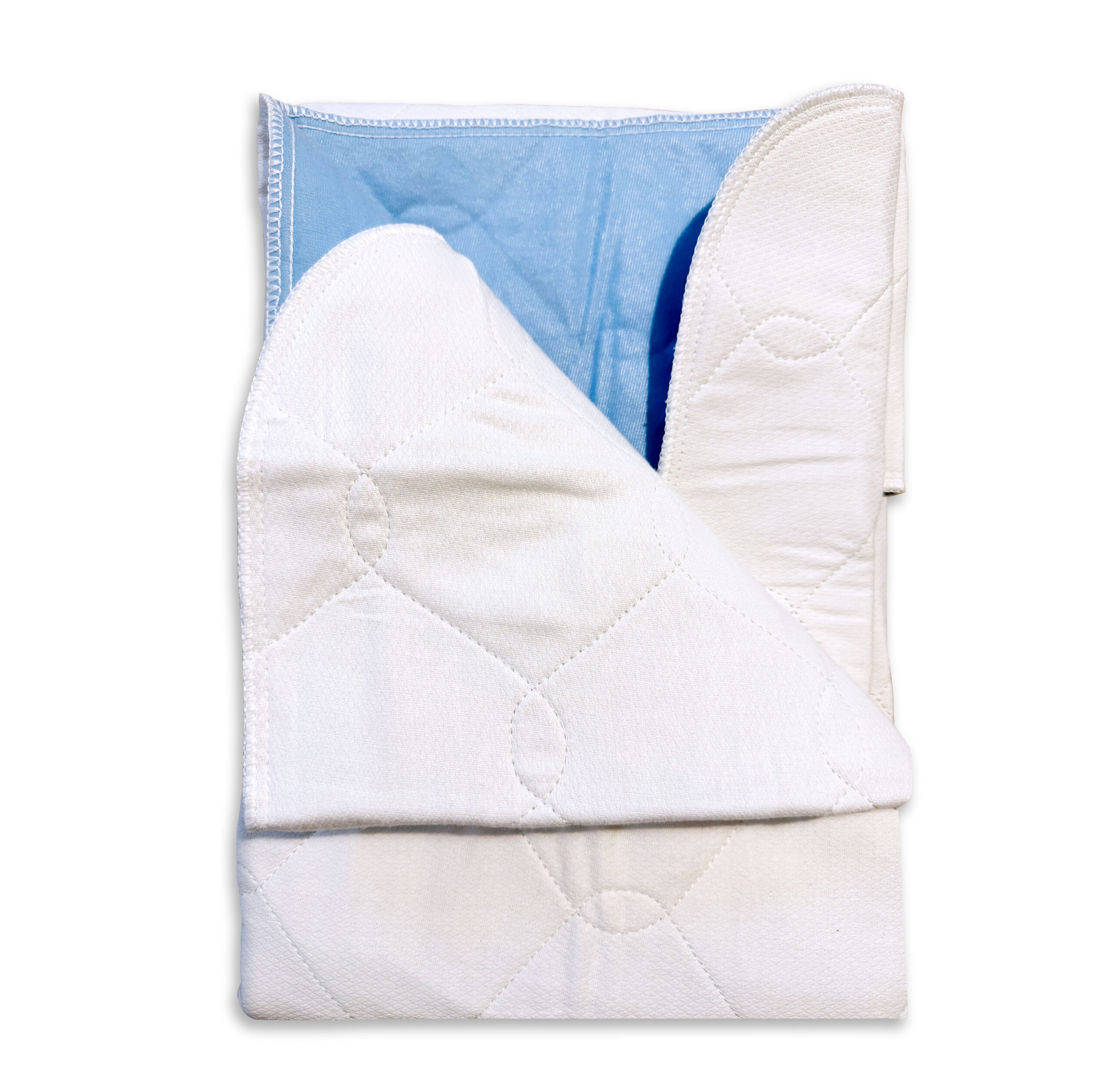
Washable bed pads have established their place in the daily work of care homes, hospitals and home care in recent years. They are a more environmentally friendly, more hygienic and, over the long term, considerably more affordable alternative to disposable bed pads. In this guide we cover when washable bed pads are the right choice, what to look out for when choosing them and how the product retains its properties through hundreds of wash cycles.
What washable bed pads are and who they suit
Washable bed pads are multi-layered, absorbent sheet-type products placed between the patient and the mattress. They collect leaks and moisture, but unlike disposable pads or paper protectors, they are washed and reused. A good washable bed pad withstands 200–300 industrial washes.
Typical situations of use include:
- Care home residents with mild or moderate incontinence
- Hospital patients in the post-operative recovery phase
- Home care clients whose relative handles the washing
- Children who experience bed-wetting
- Bedridden patients at risk of pressure ulcers
Washable bed pads do not replace a pad in heavy incontinence, but they work as an excellent additional layer of protection and significantly reduce the need for night-time changes.
Why washable bed pads are a better choice than disposables
The popularity of disposable bed pads is based on convenience — a used pad goes in the waste. However, cost, environmental load and skin health all speak in favour of washable bed pads:
Cost. One washable bed pad replaces around 200–300 disposable pads over its life cycle. The annual cost per client often halves when a unit switches to washable models.
Environment. A care home with 50 residents produces over 30,000 units of waste a year with disposable pads. Washable bed pads remove this waste almost entirely. Moving bed textiles to washable products is one of the most practical circular economy measures a public service can take.
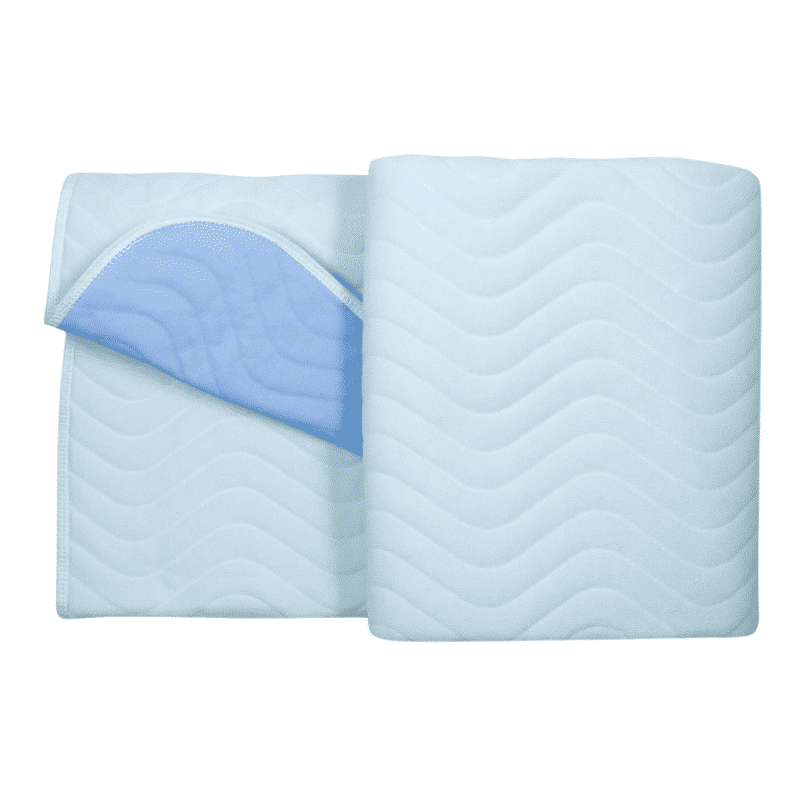
Skin health. A good washable bed pad breathes clearly better than a plastic disposable model, which reduces sweating, skin irritation and the risk of pressure ulcers.
Comfort. Washable bed pads feel softer against the skin and are quieter than disposable plastic surfaces that rustle with movement.
Choosing washable bed pads: 5 key criteria
There are several models on the market, and choosing the right product depends on the unit’s patient base and the washing method. Pay attention to the following:
1. Layer construction. Good washable bed pads are 4- or 5-layered: a soft top surface against the skin, an absorbent layer, a barrier layer and a non-slip underside. The more layers, the more absorbency.
2. Absorbency. Check how many millilitres of fluid the pad can hold. A typical 4-layer model absorbs 1,200–1,500 ml, a 5-layer one up to 2,000 ml.
3. Size. The most common sizes are 70 × 80 cm (basic size) and 90 × 110 / 90 × 115 cm (bedridden patient size). Special sizes are available for bariatric patients.
4. With or without wings. Washable bed pads with wings tuck over the edge of the mattress and do not shift when the patient moves. This is in practice essential for restless patients.
5. Wash durability. A good washable bed pad withstands industrial washing at 90 °C without the absorbent or barrier layer being damaged. In cheap models the barrier layer may break down after 30–50 washes.
Washable bed pads as part of the care package
Washable bed pads work best together with other care products. A typical combination is:
- A waterproof mattress protector under the mattress protecting the base layer
- Washable bed pads on top of the mattress protector collecting daily leaks
- A waterproof pillow protector for longer pillow life
- An incontinence bodysuit for restless residents when needed
This layered protection means that only the washable bed pad is changed daily — the mattress protector underneath lasts considerably longer. The result is less laundry work and a longer product life cycle for all bed textiles.
Care and service life of washable bed pads
Washable bed pads retain their absorbency for a long time when cared for correctly:
- Always wash at at least 60 °C, preferably 90 °C in care use
- Do not use fabric softener — it reduces absorbency by up to 30%
- Do not iron — heat damages the barrier layer
- Tumble dry only on low heat or air dry
- Check the seams and barrier layer after each wash
Over the service life, the care home should keep a record of how many wash cycles each bed pad has been through. When a product is approaching the 200-wash mark, it is worth replacing before the absorbency weakens significantly.
Certifications and safety
Good washable bed pads are Oeko-Tex Standard 100 certified. This guarantees that the product contains no chemicals harmful to the skin. The certificate is especially important because the bed pad is in direct contact with the skin for several hours at a time, and often with sensitive, ageing skin.
Check also that the product is made in the EU and that the supplier can prove traceability down to the raw materials. European manufacturing also means stricter labour oversight and a shorter supply chain. There is detailed guidance on infection control in care units from the European Centre for Disease Prevention and Control (ECDC) — this is worth reading before planning wash cycles and change frequency.
Washable bed pads and the unit’s procurement policy
More and more care units have in recent years written sustainability principles into their procurement policy, and bed textiles are the clearest target for quick change. Washable bed pads reduce waste, save costs and at the same time improve the client’s daily experience — a combination of three criteria that is rarer than you might think.
Good practices in procurement policy:
- Sustainability requirements are written as part of wider procurement guidance, not as a separate add-on
- The supplier is asked for documentation on the product’s life cycle assessment (LCA) and certificates
- The comparison calculates total cost per use, not just the unit price
- The correct wash cycle and monitoring methods are negotiated with the laundry
- Unit management tracks how many times each product has been washed — this information is the basis for the next purchase
When these things are part of the routine, washable bed pads are not just a single product but part of a wider model for sustainable care. This shows up positively in the unit’s self-monitoring, in relatives’ feedback and in municipal quality assessments.
Frequently asked questions
How often should washable bed pads be changed? Usually once a day is enough, but for bedridden patients and in heavier incontinence a change may be needed several times a day.
Can washable bed pads be washed at home in an ordinary washing machine? Yes, for home use a 60 °C programme is enough. In a care unit’s industrial washing, 90 °C is usually used to meet hygiene requirements.
What is the difference between washable bed pads and a waterproof mattress protector? The mattress protector protects the mattress and is not washed daily. Washable bed pads are the absorbent layer on top of it, changed daily as needed.
How many washable bed pads does one client need? As a rule of thumb, count at least 5–7 per client so that the wash rotation works. For a bedridden patient the number may be higher.
Why is a model with wings better for a bedridden patient? The wings tuck over the edge of the mattress and keep the pad in place even if the patient moves or the carer turns them. Without wings the pad can shift and the leak reaches the mattress.
Washable bed pads and cost calculation for the care unit
Washable bed pads are clearly a more affordable option than disposables, but the size of the saving often remains unclear until the overall calculation is done. Let us go through an example of a typical 50-place care home.
If 30 of the unit’s clients have incontinence and each has a disposable bed pad changed twice a day, the annual consumption is around 22,000 units. One disposable bed pad costs around €0.40–0.60, so the annual material cost is €8,800–13,200. On top of this come waste management costs and environmental load.
The same unit, if it switches to washable bed pads, needs around 200 units as a one-off purchase. One quality product costs €12–25, so the one-off purchase is €2,400–5,000. Washing costs are added on top, but even those are marginal compared with the material cost of disposables.
In practice the payback period is under a year, and after that the cost difference multiplies year on year. This is one of the clearest economic reasons to switch to washable products.
Washable bed pads and the unit’s workflow
Washable bed pads require a slightly different workflow than disposables. Good practices in the unit:
- Soiled pads go straight to the laundry collection, not on the floor
- A separate cycle for bed pads is agreed with the laundry — they do not go in with ordinary laundry
- The unit keeps a record of how many times each product has been washed
- Damaged pads are removed from use immediately
- Staff are trained in the correct placement of the product (wings over the mattress edge, absorbent layer on top)
When the workflow is clear from the start, the benefits of washable bed pads are realised without staff experiencing extra work.
Order washable bed pads from Inelli
Inelli supplies washable bed pads to care homes, hospitals and home care units across Northern Europe. The products are made in the EU from Oeko-Tex 100 certified materials, and the range covers 4- and 5-layer versions in different size classes.
We specialise in serving resellers and large accounts: we offer volume pricing, fast delivery and support with product selection. Request a quote directly from our become a distributor page, or explore our washable bed pad range in our online store.